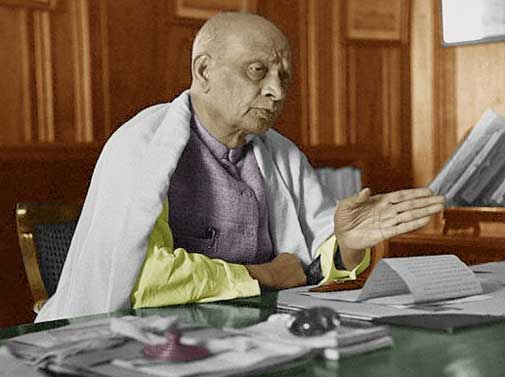
Father of the Armed Struggle Vasudev Balwant Phadke
Posted by siddhu on 10:33 AM. 'Swaraj' was only Remedy for their ills,co-founder of Maharashtra Educational society,ESSAY WRITING,essay writing on freedom fighters,Father of the Armed Struggle Vasudev Balwant Phadke,first revolutionary of modern India,india freedom,INDIAN FREEDOM FIGHTER -
Sagarmal Gopa Biography
Posted by siddhu on 12:58 PM. anti-people policies,ESSAY WRITING,essay writing on freedom fighters,FREEDOM FIGHTER,india freedom,patriot,postage stamp,sagarmal gopa biography -
NAME : SAGARMAL GOPA
BIRTH : 3 November 1900
DEATH : 4 April 1946
ACTIVITIES : Non -co-operation movement in 1921, opposed anti-people policies of then rulers of Jaisalmer
Sagarmal Gopa was a freedom fighter and patriot from Rajasthan state in India. Born on 3 November 1900 in an affluent Brahmin family in Jaisalmer he took active part in non -co-operation movement in 1921.
BIRTH : 3 November 1900
DEATH : 4 April 1946
ACTIVITIES : Non -co-operation movement in 1921, opposed anti-people policies of then rulers of Jaisalmer
Sagarmal Gopa was a freedom fighter and patriot from Rajasthan state in India. Born on 3 November 1900 in an affluent Brahmin family in Jaisalmer he took active part in non -co-operation movement in 1921.
Subhas Chandra Bose BioGraphy
Posted by siddhu on 10:22 AM. ESSAY WRITING,essay writing on freedom fighters,FOUNDER OF INDIAN NATIONAL ARMY,FREEDOM FIGHTER,india freedom,Nethaji,Subhas Chandra Bose BioGraphy -
Born:
January 23, 1897
Died: 1945(which is a mystery )
Achievements: organized Azad Hind Fauj to overthrow British Empire from India.
Subhas Chandra Bose, affectionately called as Netaji, was one of the most prominent leaders of Indian freedom struggle. Though Mahatma Gandhi and Jawaharlal Nehru have garnered much of the credit for successful culmination of Indian freedom struggle, the contribution of Subash Chandra Bose is no less. He has been denied his rightful place in the annals of Indian history. He founded Indian National Army (Azad Hind Fauj) to overthrow British Empire from India and came to acquire legendary status among Indian masses.
Subhash Chandra Bose Gallery
Posted by siddhu on 7:19 PM. ESSAY WRITING,essay writing on freedom fighters,FOUNDER OF INDIAN NATIONAL ARMY,india freedom,INDIAN FREEDOM FIGHTER,Subhash Chandra Bose Gallery - No comments
Chandra Shekhar Azad Biography
Posted by siddhu on 11:57 AM. Chandra Shekhar Azad Biography,ESSAY WRITING,essay writing on freedom fighters,india freedom,INDIAN FREEDOM FIGHTER - 1 comment
“दुश्मन की गोलियों का हम सामना करेंगे,
आजाद ही रहे हैं, आजाद ही रहेंगे.”
("We will face the bullets of the enemies, we are free and will remain free")
NAME : Chandra Sekhar Azad
BORN : 23 July 1906
DIED : 27 February 1931 (aged 24)
Chandra Shekhar Azad , popularly known as Azad ("The Liberated"), was one of the most important Indian revolutionaries who reorganised the Hindustan Republican Association under the new name of Hindustan Socialist Republican Association (HSRA) after the death of its founder Pandit Ram Prasad Bismil and three other prominent party leaders, Thakur Roshan Singh, Rajendra Nath Lahiri and Ashfaqulla Khan. He is considered to be the mentor of Bhagat Singh and chief strategist of the HSRA.
Vinoba Bhave Biography
Posted by siddhu on 7:40 PM. ESSAY WRITING,essay writing on freedom fighters,india freedom,INDIAN FREEDOM FIGHTER,nonviolent movement,Vinoba Bhave Biography - 1 comment
"All revolutions are spiritual at the source. All my activities have the sole purpose of achieving a union of hearts"
- Vinoba Bhave
NAME : Vinoba BhaveBIRTH : 11 September 1895
Gagode, British India
DEATH : 15 November 1982
Vinoba stands as a symbol for the struggle of the good against the evil,
of spiritual against the mundane. He was a spiritual visionary, whose
spirituality had a pragmatic stance with intense concern for the deprived.
He was a brilliant scholar who could knowledge accessible to ordinary people.
He was Gandhi's ardent follower, who could retain originality in thinking.
As S. Radhakrishnan pointed out, "Indeed his life represents harmonious
blend of learning, spiritual perception and compassion for the lowly and
the lost." His Bhoodan (Gift of the Land) movement started on April 18,
1951, he attracted the attention of the world. Untouched by publicity and
attention, Vinoba had continued his efforts for a just and equitable
society. In fact, his life is a saga of his commitment to nonviolent ways
of bringing change, his yearning for the highest level of spirituality and
his unwavering faith in human values and love.
Sardar Vallabhbhai Jhaverbhai Patel BIOGRAPHY
Posted by siddhu on 9:10 PM. ESSAY WRITING,essay writing on freedom fighters,india freedom,IRON MAN OF INDIA,Sardar Vallabhbhai Jhaverbhai Patel,Sardar Vallabhbhai Jhaverbhai Patel BIOGRAPHY - 2 comments
Iron Man of India
NAME : Sardar Vallabhbhai Jhaverbhai Patel
BIRTH : 31 October 1875
DEATH : 15 December 1950
Sardar Vallabhbhai Patel the iron-man of India was born on 31st October, 1875, in a small village in Nadiad. His father Jhaverbhai Patel
was a simple farmer and mother Laad Bai was a simple lady. From his
childhood itself, Patel was a very hard-working individual. He used to
help his father in farming and studied in a school at N. K. High school, Petlad.
He passed his high-school examination in 1896. Throughout school he was
a very wise and intelligent student. Inspite of poor financial
conditions his father decided to send him to college but Vallabhbhai
refused. Around three years he stayed at home, worked hard and prepared
for the District Leader's examination, hence passing with very good
percentage.
Sardar Vallabhbhai Patel is a
historical figure who moves you to tears. Mostly these are tears of joy,
for he achieved a thrilling Indian unity. Yet some are tears of pity,
for the Sardar suffered and sacrificed much. Sardar Patel
hated to work for anyone especially the Britishers. He was a person of
independent nature. He started his own practice of law in a place called
Godhara. Soon the practice flourished. He saved money, made financial
arrangement for the entire family. He got married to Jhaberaba. In 1904,
he got a baby daughter Maniben, and in 1905 his son Dahya was born. He
sent his elder brother to England for higher studies in law. In 1908,
Vitthabhai returned as barrister and started practising in Bombay. In
1909 his wife became seriously ill and was taken to Bombay for treatment
Vallabhbhai had to go for the hearing of an urgent case and his wife
died. He was stunned. He admitted his children in St. Mary's school
Bombay, and he left for England. He became a barrister and retuned to
India in 1913.
He started his practice in Ahmedabad and soon he
became aware of the local life, activities and people's problems. He
became an extremely popular person and he got elected in the Municipal
Corportaion in 1917. Around 1915, he came across Mahatma Gandhi. The
Swadeshi Movement was at its peak. Gandhiji gave a
lecture at a place in Ahmedabad where Patel heard him and was very
impressed and started actively participating in the freedom movement.
The British government's atrocities were increasing. The government
declared to confiscate all the lands of farmers. He forced the British
government to amend the rules. He brought together the farmers and
encouraged them and hence got the title of 'Sardar' and thus became famous.
The British government considered him as a threat and
his lectures were considered anti-government and he was imprisoned
several times. In 1942, he took part in the Quit India Movement under
the leadership of Mahatma Gandhi. He was arrested along with other
leaders and was sent to Ahmednagar jail. Inspite of the British Rule,
rulers of the small kingdoms were spending a lot of public money, and
were having a nice time. Sardar Vallabh Bhai opposed this.
With
great wisdom and political foresight, he consolidated the small
kingdoms. The public was with him. He tackled the Nizam of Hyderabad and
the Nawab of Junagarh who intially did not want to join India. There
were a lot of problems connected with the reunion of the numerous states
into India. Sardar Patel's untiring efforts towards the unity of the country brought success. Due to the achievement of this massive task, Sardar Patel
got the title of 'Iron Man'. ' He is one of the prestigious leaders of
the world who became immmortal by uniting a scattered nation without any
bloodshed. His enthusiasm to work for the independent nation got a big
jolt when Gandhiji was murdered. Patel was very attached to Gandhiji and considered him, his elder brother and teacher. He was encouraged by Mahatma Gandhi in all his work. Gandhiji's
death left him broken. On 15th December, 1950 he died of a cardiac
arrest. The news of his death spread all over the world. The entire
nation plunged into deep sorrow, everyday life came to a standstill. A
grateful nation paid a tearful homage to it's beloved leader. In 1991
the grateful nation conferred upon him the honour of Bharat Ratna.
His strength of character, the sharpness of his mind,
his organizing skills, and all his energy were offered up for achieving
the freedom of India under Gandhi's leadership, and after independence
for India's consolidation. We admire a man who rises to a political or
financial peak, but are moved by one whose sole purpose in life is the
strength and wellbeing of his compatriots. And we are moved even more
when we discover that next to the steel in his soul is a tenderness for
colleagues and a readiness to accept whatever results God ordains. In
successive phases of his life, Vallabhbhai Patel showed
the defiance of the oppressed, a trial lawyer's brilliance, the daring
to give up a flourishing career, the discipline of a soldier in
freedom's battles, the strategies of a General, indifference as a
prisoner of the Raj, the generosity of the strong, the firmness of a
patriot, and the farsightedness of a statesman. If times are depressing
or daunting, Sardar Patel reminds us of India's and Indians' potential. When times are good, we can think of him with glad gratitude.
SWAMY VIVEKANANDA BIOGRAPHY
Posted by siddhu on 12:03 PM. ESSAY WRITING,essay writing on freedom fighters,india freedom,SWAMY VIVEKANANDA BIOGRAPHY - 1 comment
BIRTH
NAME : Narendra Nath Datta
BORN : 12 January 1863 Calcutta, India
DIED : 4 July 1902 (aged 39) Belur Math near Calcutta, India
Swami Vivekananda was the chief disciple of the 19th century saint Ramakrishna and the founder of the Ramakrishna Math and the Ramakrishna Mission. He is considered a key figure in the introduction of Indian philosophies of Vedanta and Yoga to the "Western" world, mainly in America and Europe and is also credited with raising interfaith awareness, bringing Hinduism to the status of a major world religion during the end of the 19th century CE. Vivekananda is considered to be a major force in the revival of Hinduism in modern India. He is perhaps best known for his inspiring speech which began: "Sisters and Brothers of America," through which he introduced Hinduism at the Parliament of the World's Religions in Chicago in 1893.
Swami Vivekananda was born in an aristocratic Bengali Kayastha family of Calcutta
on 12 January 1863. Vivekananda's parents influenced his thinking—his
father by his rationality and his mother by her religious temperament.
From his childhood, he showed an inclination towards spirituality and God realisation. His guru, Ramakrishna, taught him Advaita Vedanta (non-dualism); that all religions are true and that service to man was the most effective worship of God. After the Mahasamadhi of his guru, Vivekananda became a wandering monk, touring the Indian subcontinent
and acquiring first-hand knowledge of conditions in India. He later
travelled to Chicago and represented India as a delegate in the 1893
Parliament of World Religions. He conducted hundreds of public and
private lectures and classes, disseminating Vedanta and Yoga in America,
England and Europe. He also established the Vedanta societies in America and England.
At the same time, vehement in his desire to know the truth about God, he questioned people of holy reputation, asking them if they had seen God. He found such a person in Sri Ramakrishna, who became his master, allayed his doubts, gave him God vision, and transformed him into sage and prophet with authority to teach.
After Sri Ramakrishna's death, Vivekananda renounced the world and criss-crossed India as a wandering monk. His mounting compassion for India's people drove him to seek their material help from the West. Accepting an opportunity to represent Hinduism at Chicago's Parliament of Religions in 1893, Vivekananda won instant celebrity in America and a ready forum for his spiritual teaching.
For three years he spread the Vedanta philosophy and religion in America and England and then returned to India to found the Ramakrishna Math and Mission. Exhorting his nation to spiritual greatness, he wakened India to a new national consciousness. He died July 4, 1902, after a second, much shorter sojourn in the West. His lectures and writings have been gathered into nine volumes.
------------------------------------------------------------------------------------------------------- REFERRED LINKS:
http://en.wikipedia.org/wiki/Swami_Vivekananda
http://www.vivekananda.org/biography.asp